Outline the Data Generation Process
Lesson

Elijah Galvan
September 1, 2023
4 min read
Goal During this Stage
Before we can start to develop an mathematical model of behavior, we have to establish a conceptual model of how Decisions are made in your scenario that comports with your hypotheses.
How to Achieve this Goal
Identify Motives Per Hypothesis - for each hypothesis, think of the central appetitive or aversive motive that would lead people to make such Decisions
Identify Behavioral Patterns Predicted by Each Hypothesis - think about how the Decisions people make enable them to act on their environment ( Independent Variables and Constants ) to avoid or obtain whatever is motivating them according to each hypothesis
Explain How Other Behaviors Prevent Preferences From Being Met - now think about how other Decisions that people could make would prevent them from avoiding or obtaining whatever is motivating them according to each hypothesis.
Identify Dimenions of Differences Between People - taking a step back now, identify the dimensions which are implied by the Meaningful Psychological Differences Between People you have identified in your hypotheses - what way are these people quantitatively different?
Note
The central theoretical question we want our Equation to answer is this:
What Meaningful Psychological Differences Between People determine how much Utility they derive from their Decisions in any situation of interest, where the situation as defined by the Independent Variables and Constants.
Following these steps should enable you to answer this question in a conceptual way: you now have a conceptual model of how Independent Variables, Constants , and Decisions relate to the Meaningful Psychological Differences Between People identified by each hypothesis. In the next step you are going to translate your conceptual answer to a mathematical one by creating a Utility equation.
Tutorials
Tutorial 1 - van Baar, Chang, & Sanfey, 2019
Identify Motives Per Hypothesis
Greed - a desire to obtain money (or an aversion to losing money)
Inequity Aversion - an aversion to creating inequity (or a desire to achieve equity)
Guilt Aversion - an aversion to violating others’ expectations (or a desire to meet others’ expectation)
Identify Behavioral Patterns Predicted by Each Hypothesis
Greed - people keep and take as much money as they can
Inequity Aversion - people give back enough money so that them and their partner have an equal amount
Guilt Aversion - people give back enough money so that their partners’ expectations are met
Explain How Other Behaviors Prevent Preferences From Being Met
Greed - not keeping (or taking) as much money as one possibly can does not maximize one’s payoff
Inequity Aversion - not giving enough money back so that them and their partner have an equal amount results in inequity
Guilt Aversion - not giving their partner what they expect results in the violation of another person’s expectations which results in feeling guilty
Identify Dimensions of Differences Between People
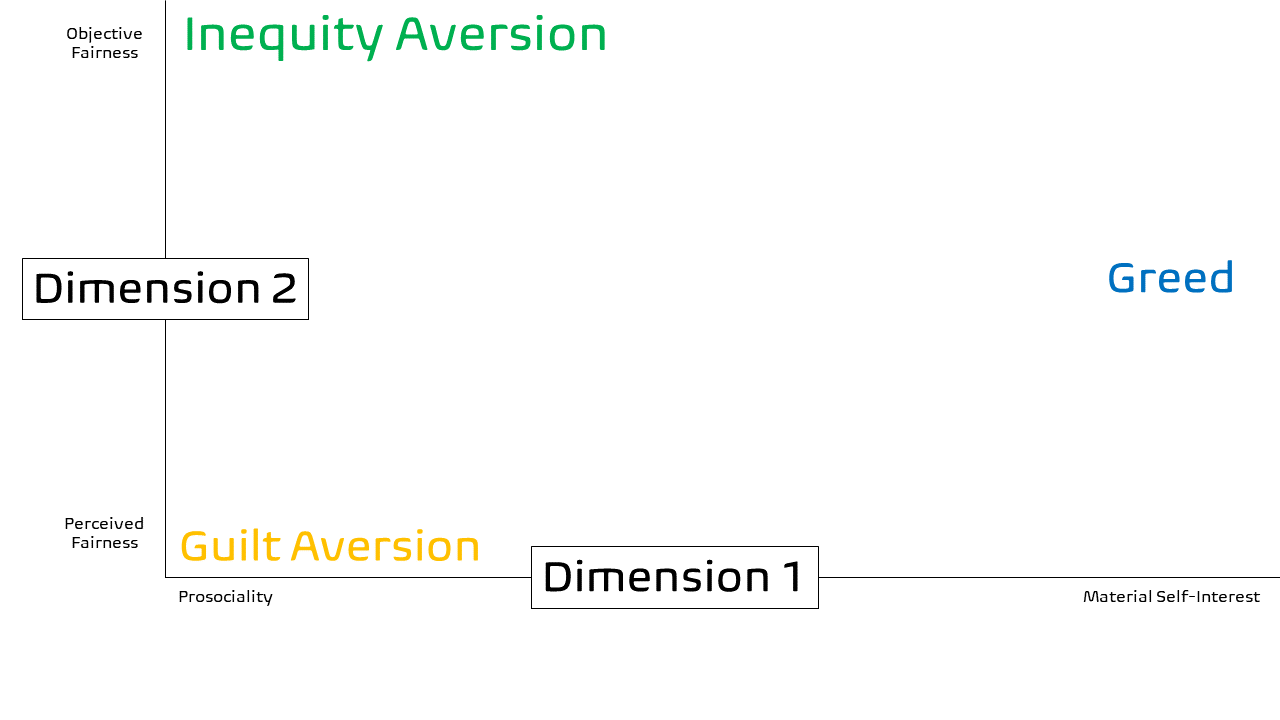
Greedy people act in their own material self-interest while both Inequity Averse and Guilt Averse people act in others’ self-interest
Inequity Averse people act in others’ material self-interest based on a desire to maintain equality - to be objectively fair
Guilt Averse people are motivated to act in others’ material self-interest based on a desire to meet expectations - to be perceived as being fair
Dimensions:
D1 - ranges from prosociality (low) to greed (high)
D2 - ranges from acting based on perceived fairness (low) to objective fairness (high)
In our lab, to keep things simple we always refer to D1 as Θ (Theta) and we associate low values with prosocial preferences and associate high values with selfish preferences.
We also always refer to D2 as Φ (Phi) and we select which social norm it will refer to on an arbitrary basis.
Tutorial 2 - Galvan & Sanfey, 2024
Identify Motives Per Hypothesis
Payout-Maximization - a desire to obtain money (or an aversion to losing money)
Equality-seeking - a desire for everyone to have the same amount (or an aversion to people having different amounts)
Equity-seeking - a desire to preserve the preexisting distribution of resources (or an aversion to changing this distribution)
Identify Behavioral Patterns Predicted by Each Hypothesis
Payout-Maximization - people redistribute as a means by which to get as much money as possible
Equality-seeking - people redistribute to ensure everyone has the same amount
Equity-seeking - people redistribute to ensure that everyone has what they were initially allocated
Explain How Other Behaviors Prevent Preferences From Being Met
Payout-Maximization - not redistributing in order to receive as much money as one possibly can does not maximize one’s payoff
Equality-seeking - not redistributing as much as possible prevents everyone from having the same amount
Equity-seeking - redistributing takes money away from people who deserve to keep it
Identify Dimensions of Differences Between People
D1 - ranges from prosociality (low) to greed (high)
D2 - ranges from equity (low) to equality (high)
So Payout-Maximizers are characterized at all high values of D1 while Equity-seekers and Equality-seekers are characterized at low values of D1. Meanwhile Equity-seekers and Equality-seekers are differentiated by D2
Tutorial 3 - Crockett et al., 2014
Identify Motives Per Hypothesis
Before answering our question about how harm-aversion changes depending on Shock Recipient, we have to answer a more basic question; namely,
What motivates decision-making in harm-for-benefit situations?
Thus, we have to assess what could motivate behavior in either Condition?
Harm-Aversion - a desire to avoid causing harm
Payout-Maximization - a desire to obtain money
Identify Behavioral Patterns Predicted by Each Hypothesis
Harm-Aversion - people always choose the less harmful option
Payout-Maximization - people always choose the highest paying option
However, based on our task, we may wish to account for a loss aversion. This is because we are giving someone an default value that they must choose to lose out on in favor of something else. To be exhaustive at this stage, we should indeed account for this as it applies to causing more harm or receiving less payout, depending on what the default is.
Loss-Aversion
Explain How Other Behaviors Prevent Preferences From Being Met
Harm-Aversion - choosing the more harmful option results causing more harm
Payout-Maximization - choosing the lower paying option results in less money
Loss-Aversion - choosing an option with either more shocks or less money is less desirable since it causes one to lose out on the option with either fewer shocks or more money
Identify Dimensions of Differences Between People
D1 - ranges from harm-averse (low) to payout-maximizing (high)
D2 - ranges from valuing losses and gains equally (1) to being very loss-averse (high)
Tutorial 4 - Li et al., 2022
Identify Motives Per Hypothesis
Inequality Aversion - an aversion to creating inequality (or a desire to achieve equality)
Harm Aversion - a desire to avoid causing taking money from others (harming them)
Rank Reversal Aversion - a desire to avoid usurping an existing hierarchy
Identify Behavioral Patterns Predicted by Each Hypothesis
Inequality Aversion - people chose a division of resources where both players have equal amounts (or as close to equal as possible)
Harm Aversion - people chose a division of resources where neither player loses money (or both players lose as little as possible)
Rank Reversal Aversion - people chose a division of resources that maintains the existing hierarchy (i.e. the richer player initially still has more and the poorer player initially still has less)
Explain How Other Behaviors Prevent Preferences From Being Met
Inequality Aversion - chosing a less harmful option produces more inequality
Harm Aversion - chosing a more equal option produces less inequality
Rank Reversal Aversion - chosing a more equal option reverses hierarchy (when this is possible)
Identify Dimensions of Differences Between People
D1 - level of aversion to inequality (higher is more averse)
D2 - level of aversion to harm (higher is more averse)
D3 - level of aversion to reversing rank (higher is more averse)